
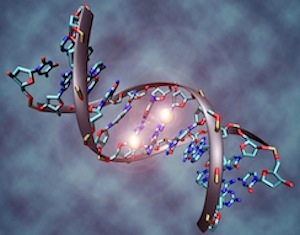
Model of a methylated DNA molecule; image by Christoph Bock (Max Planck Institute for Informatics) via Wikimedia Commons.
Epigenetic alterations, particularly in DNA methylation, are ubiquitous in cancer, yet the molecular origins and the consequences of these alterations are poorly understood. CTCF, a DNA-binding protein that regulates higher-order chromatin organization, is frequently altered by hemizygous deletion or mutation in human cancer. To date, a causal role for CTCF in cancer has not been established. Here, we show that Ctcf hemizygous knockout mice are markedly susceptible to spontaneous, radiation-, and chemically induced cancer in a broad range of tissues. Ctcf(+/-) tumors are characterized by increased aggressiveness, including invasion, metastatic dissemination, and mixed epithelial/mesenchymal differentiation. Molecular analysis of Ctcf(+/-) tumors indicates that Ctcf is haploinsufficient for tumor suppression. Tissues with hemizygous loss of CTCF exhibit increased variability in CpG methylation genome wide. These findings establish CTCF as a prominent tumor-suppressor gene and point to CTCF-mediated epigenetic stability as a major barrier to neoplastic progression. (publication abstract)