
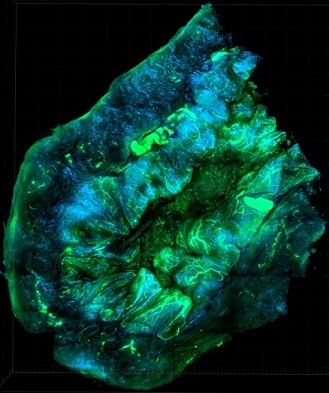
Ovarian Tumor Microenvironment. Source: National Cancer Institute \ Comprehensive Cancer Center of Wake Forest Univ.,Creators: Chris Booth, Kyle Cowdrick, Frank C. Marini
Platinum resistance is one of the most challenging problems in ovarian cancer treatment. High-throughput functional siRNA screening identified tyrosine kinase with immunoglobulin-like and EGF-like domains 1 (TIE-1) as a gene that confers cells resistant to cisplatin. Conversely enforced over-expression of TIE-1 was validated to decrease cisplatin sensitivity in multiple ovarian cancer cell lines and up-regulation of TIE-1 was correlated with poor prognosis and cisplatin resistance in patients with ovarian cancer. Mechanistically, TIE-1 up-regulates the nucleotide excision repair (NER) system mediated by xeroderma pigmentosum complementation group C (XPC), thereby leading to decreased susceptibility to cisplatin-induced cell death without affecting cisplatin uptake and excretion. Importantly potentiation of therapeutic efficacy by TIE-1 inhibition was selective to DNA-adduct-type chemotherapeutic platinum reagents. Therefore, TIE-1 is suggested to promote XPC-dependent NER, rendering ovarian cancer cells resistant to platinum. Accompanied with novel findings, TIE-1 could represent as a novel therapeutic target for platinum-resistant ovarian cancer.