
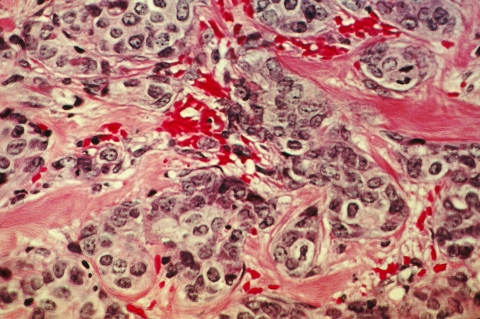
Hematoxylin and Eosin stained breast cancer tissue.
Image courtesy of National Institute of Health
Improved biomarker tests are required to minimize overdiagnosis and overtreatment of breast cancers. A number of pathologic criteria have been established to differentiate indolent or aggressive behavior, such as Nottingham grade of cancer cells. However, the effects of the tumor microenvironment on patient outcomes have not been integrated into pathologic criteria. In the current study, the Reactive subtype of breast cancer, identified by reverse-phase protein arrays, was demonstrated to indicate a favorable outcome. The lowest risk tumors, typically estrogen receptor (ER)-positive breast cancer tumors, were more likely to have high expression of stromal proteins, high intratumoral stromal volume, and increased cell density within the stromal compartment. ER-positive/HER2-negative disease with a Reactive protein signature had a high intratumoral stromal content and an excellent prognosis.