
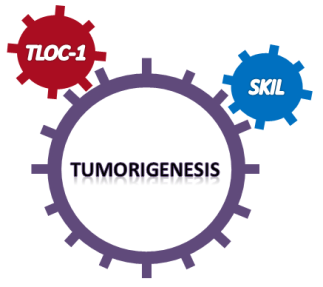
Adapted from Cancer Discovery 2013 Sept; 3(9)
Abstract: 3q26 is frequently amplified in several cancer types with a common amplified region containing 20 genes. To identify cancer driver genes in this region, we interrogated the function of each of these genes by loss- and gain-of-function genetic screens. Specifically, we found that TLOC1 (SEC62) was selectively required for the proliferation of cell lines with 3q26 amplification. Increased TLOC1 expression induced anchorage-independent growth, and a second 3q26 gene, SKIL (SNON), facilitated cell invasion in immortalized human mammary epithelial cells. Expression of both TLOC1 and SKIL induced subcutaneous tumor growth. Proteomic studies showed that TLOC1 binds to DDX3X, which is essential for TLOC1-induced transformation and affected protein translation. SKIL induced invasion through upregulation of SLUG (SNAI2) expression. Together, these studies identify TLOC1 and SKIL as driver genes at 3q26 and more broadly suggest that cooperating genes may be coamplified in other regions with somatic copy number gain.