
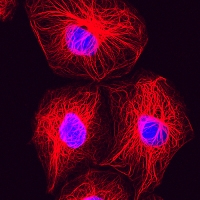
Breast cancer cells. Cytoskeletal proteins are shown in red and DNA is shown in blue. Source: Lutz Langbein, German Cancer Research Center via Medical Xpress.
There is an urgent need in oncology to link molecular aberrations in tumors with therapeutics that can be administered in a personalized fashion. One approach identifies synthetic-lethal genetic interactions or emergent dependencies that cancer cells acquire in the presence of specific mutations. Using engineered isogenic cells, we generated a systematic and quantitative chemical-genetic interaction map that measures the influence of 51 aberrant cancer genes on 90 drug responses. The dataset strongly predicts drug responses found in cancer cell line collections, indicating that isogenic cells can model more complex cellular contexts. Applied to triple-negative breast cancer, we report clinically actionable interactions with the MYC oncogene including resistance to AKT/PI3K pathway inhibitors and an unexpected sensitivity to dasatinib through LYN inhibition in a synthetic-lethal manner, providing new drug and biomarker pairs for clinical investigation. This scalable approach enables the prediction of drug responses from patient data and can be used to accelerate the development of new genotype-directed therapies. (Publication Abstract)