
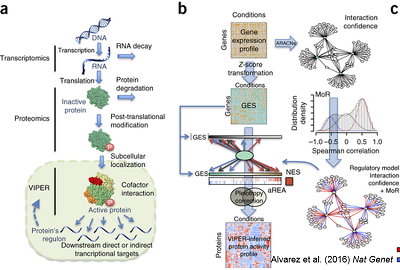
An overview of VIPER approach and workflow. Posted with permission from Nature Genetics https://www.ncbi.nlm.nih.gov/pubmed/27322546
Identifying the multiple dysregulated oncoproteins that contribute to tumorigenesis in a given patient is crucial for developing personalized treatment plans. However, accurate inference of aberrant protein activity in biological samples is still challenging as genetic alterations are only partially predictive and direct measurements of protein activity are generally not feasible. To address this problem we introduce and experimentally validate a new algorithm, virtual inference of protein activity by enriched regulon analysis (VIPER), for accurate assessment of protein activity from gene expression data. We used VIPER to evaluate the functional relevance of genetic alterations in regulatory proteins across all samples in The Cancer Genome Atlas (TCGA). In addition to accurately infer aberrant protein activity induced by established mutations, we also identified a fraction of tumors with aberrant activity of druggable oncoproteins despite a lack of mutations, and vice versa. In vitro assays confirmed that VIPER-inferred protein activity outperformed mutational analysis in predicting sensitivity to targeted inhibitors. (Publication Abstract)