
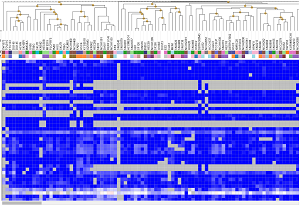
Researchers used the Cancer Therapeutics Response Portal to determine mechanisms of action for small molecules such as ML239.
Changes in cellular gene expression in response to small-molecule or genetic perturbations have yielded signatures that can connect unknown mechanisms of action (MoA) to ones previously established. We hypothesized that differential basal gene expression could be correlated with patterns of small-molecule sensitivity across many cell lines to illuminate the actions of compounds whose MoA are unknown. To test this idea, we correlated the sensitivity patterns of 481 compounds with ∼19,000 basal transcript levels across 823 different human cancer cell lines and identified selective outlier transcripts. This process yielded many novel mechanistic insights, including the identification of activation mechanisms, cellular transporters and direct protein targets. We found that ML239, originally identified in a phenotypic screen for selective cytotoxicity in breast cancer stem-like cells, most likely acts through activation of fatty acid desaturase 2 (FADS2). These data and analytical tools are available to the research community through the Cancer Therapeutics Response Portal. (Publication abstract)