
Cell (2012)
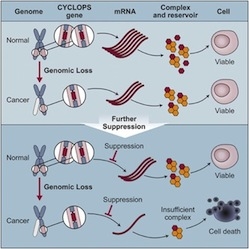
Integrated analysis of RNAi and copy number data across a panel of cancer cell lines revealed the CYCLOPS (copy number alterations yielding cancer liabilities owing to partial loss) genes, which include components of the spliceosome, ribosome and proteasome, as potential candidates for targeted cancer therapies. Partial loss of these genes may make tumor cells more sensitive than normal cells to gene suppression with targeted agents. In support of this theory, knockdown of the highest-ranked CYCLOPS candidate, the proteasome gene PSMC2, was shown to inhibit growth of ovarian tumor xenografts. The finding that passenger alterations in cancer cells can be therapeutically targeted, and not just the genes driving the cancer phenotype, experimentally validates an important concept in cancer research.