
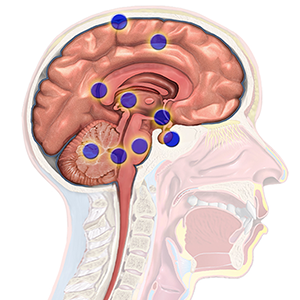
Brain cancer regions https://creativecommons.org/licenses/by/4.0/
Interstitial fluid pressure (IFP) presents a barrier to drug uptake in solid tumors, including the aggressive primary brain tumor glioblastoma multiforme (GBM). It remains unclear how fluid dynamics impacts tumor progression and can be targeted therapeutically. To address this issue, a novel telemetry-based approach was developed to measure changes in IFP during progression of GBM xenografts. Antisecretory factor (AF) is an endogenous protein that displays anti-secretory effects in animals and patients. Here, endogenous induction of AF protein or exogenous administration of AF peptide reduced IFP and increased drug uptake in GBM xenografts. AF inhibited cell volume regulation of GBM cells, an effect that was phenocopied in vitro by the sodium-potassium-chloride co-transporter 1 (SLC12A2/NKCC1) inhibitor bumetanide. As a result, AF induced apoptosis and increased survival in GBM models. In vitro, the ability AF to reduce GBM cell proliferation was phenocopied by bumetanide and NKKC1 knockdown. Next, AF's ability to sensitize GBM cells to the alkylating agent temozolomide, standard of care in GBM patients, was evaluated. Importantly, combination of AF induction and temozolomide treatment blocked regrowth in GBM xenografts. Thus, AF-mediated inhibition of cell volume regulation represents a novel strategy to increase drug uptake and improve outcome in GBM.